
ESG, SRI, and Impact Investing: is there a difference?
“Deciding is freedom. Indecision is torture.”

Why is the prerequisite to which.
Options overload the mind’s synapses. Without a filter, the clear path ahead is dammed with a blunt paralysis. The filter is your why.
ESG vs SRI vs Impact Investing
ESG, SRI, and impact investing are related but distinct: ESG manages risk, SRI screens by values, and impact investing pursues measurable positive change.
In 1885, Wilson A. Bentley discovered no two snowflakes are alike—no matter how much the naked eye demands otherwise. Similarly, ESG, SRI, and Impact Investing share resembling features until you look deeper. As you peel back the layers of these investing onions, you’ll notice fraternal and identical features.
Environmental, Social, and Governance
Company analysts employ various financial instruments to measure free cash flow, EBITDA, PE ratios, and other nuanced indicators. Financial metrics like these paint detailed pictures of a company’s health and outlook. But as institutions deployed capital to protest apartheid in South Africa, Agent Orange in Vietnam, and Slavery in mid-18th century U.S., the world took notice that financial metrics alone paint a lacking picture. The remedy: an integration of environmental, social, and corporate governance issues, as non-financial instruments, into company analysis.
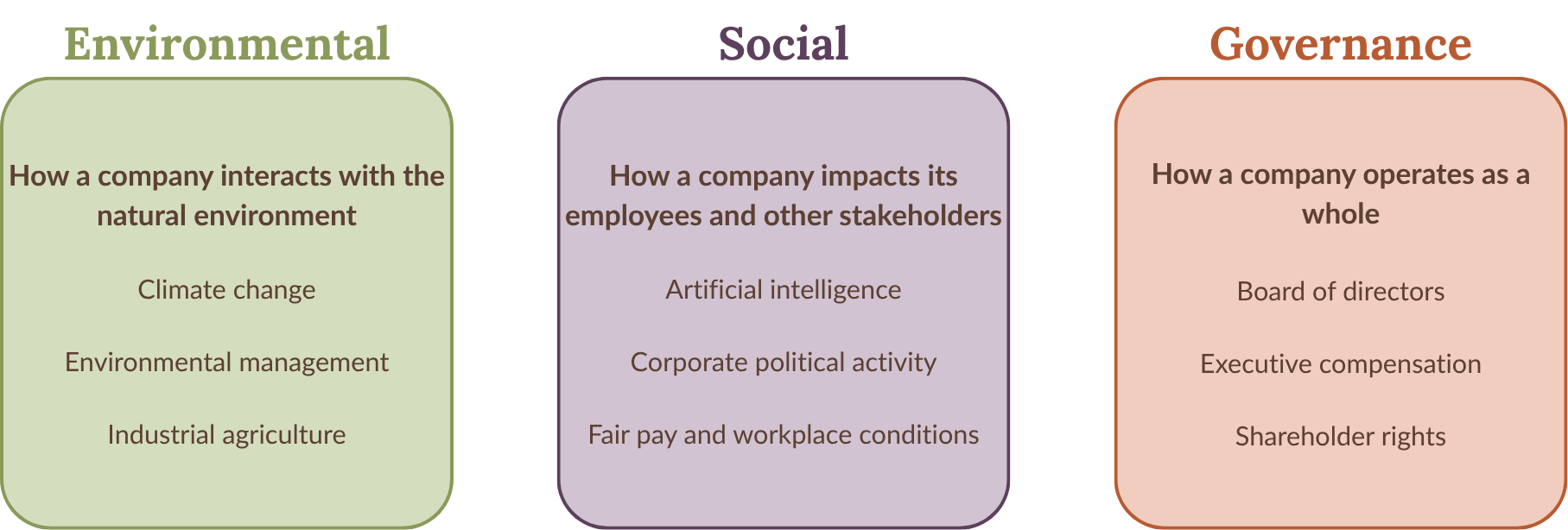
Environmental, Social, and Governance issues defined with examples.
ESG harbors many faces, but it’s inception was designed for company analysis. An ESG investment won’t necessarily exclude an oil company (or any other seemingly non-ESG-beneficial company). Instead, it analyzes the risks residing in that company’s practices on a best-in-class basis. If an oil company is encouraging more environmentally-friendly procedures relative to its peers, but is still an oil company, it can be considered an ESG investment.
the jist
The roots of these values-based investing pillars are seated in religion and watershed political moments. Socially Responsible Investing (SRI) is the grandmother to ESG and Impact Investing, with her roots taking major hold in the late 20th century. The Quakers and Methodists divested from companies directly or indirectly supporting apartheid in South Africa—birthing a monumental case for socially responsible investing. The United Nation’s took notice and wanted to provided businesses an ethical armature to financial reporting. In 2004, the UN published “Who Cares Wins.” This report lent guidance on how businesses can integrate environmental, social, and corporate governance issues into analyses—coining ESG. Closely behind, The Rockefeller Foundation coined Impact Investing in 2007 to describe investments made with the explicit intention of generating positive social or environmental change.
Shifting our focus to 2026, the values-based investing landscape is a smorgasbord of seemingly different-yet-identical strategies. ESG is no longer just a framework for businesses to integrate non-financial issues into analysis—it’s a union of analysis, screening, and impact. These pillars—ESG, SRI, and Impact Investing—are not as easily separable as they once were, but their individual contributions continue to shape an evolving environment.
Socially Responsible Investing
Quakers, Methodists, and other congregations have married social responsibility with currency for millennia. Socially Responsible Investing is a belief system embedded into how people use their money—contextually, where they invest. This approach walks away from companies not supporting environmental and social benefit entirely via two primary methods: negative and positive screening.
Negative screening: Avoids investment into companies and/or whole industries dependent on an investor’s values.
An investor who values more social equity might avoid investment into Amazon—a known union opponent.
Positive screening: Leans investment into companies already aligned with an investor’s values.
An investor who values less pesticides in food might lean investment into Nestlé—a proponent of phasing out glyphosate.
Negative and positive screening are just two methods, but the goal of SRI is to keep your money in companies you align with.
Impact Investing
Born from the philosophy that money not only inspires, but directly impacts change, Impact Investing points its full attention to outcomes. This values-aligned investing strategy narrows the investment objective to material, measurable, and quantifiable outcomes. An investor who values specific change, such as solar micro-grid initiatives in an undeveloped country or equitable housing development in the U.S., will allocate investment specifically for causes they align with. The Rockefeller Foundation took notice of this money capability and coined the term in 2007.
What does ESG, SRI, and Impact Investing look like in 2026?
As of 2023, the market value of values-aligned investing topped $27B USD, with expectations pushing that value to over $130B USD by 2032. But, value is not the driving force—its values. Adoption by individuals and corporations alike grow in unison, regardless of political whiplash, public controversy, and general confusion. People desire an alignment of investments and values.
This desire has shifted the ground in which ESG, SRI, and Impact Investing laid their roots. Socially Responsible Investing came primarily through religion, Environmental-Social-Governance Investing through company analysis, and Impact Investing through measurable outcomes. Today, these differences lay under a thick skin of similarities.
Branding is part of the blame. An ESG-labeled impact ETF begs the question: is this ESG or Impact Investing? Now, more than ever, a look under the hood is indispensable. The methodologies composing the investment will inform the investor how, why, and what about its design. This level is detail should avail itself on the company’s website, disclosures of an investment, and other accessible places.
Although it requires due diligence to understand where your money is being allocated, these pillars of values-aligned investment continue our walk towards a more environmentally and socially beneficial investing landscape.
Disclosures:
Just Advising LLC is a Registered Investment Adviser in the state of North Carolina. Advisory services are only offered to clients or prospective clients where Just Advising LLC and its representatives are properly registered or exempt from registration. Justin Horowitz is an investment adviser representative of Just Advising LLC. The firm is a registered investment adviser and only conducts business in jurisdictions where it is properly registered, or is excluded or exempted from registration requirements. Registration as an investment adviser is not an endorsement of the firm by securities regulators and does not mean the adviser has achieved a specific level of skill or ability.
Content is for educational purposes only and does not constitute a solicitation or offer to buy/sell any securities or provide personalized investment advice. Past performance is no guarantee of future results. All investments involve risk, including the loss of principal. “Likes” should not be considered a positive reflection of the investment advisory services offered by Just Advising LLC. "Likes," "Shares," or "Comments" are not endorsements of any individual or service. Just Advising LLC is not responsible for the content or accuracy of third-party websites linked herein. Comments are monitored but should not be considered testimonials.
The information presented on this post is believed to be factual and up-to-date, but we do not guarantee its accuracy and it should not be regarded as a complete analysis of the subjects discussed. Comments should not be construed as an offer to buy or sell, or a solicitation of an offer to buy or sell the investments mentioned. A professional adviser should be consulted before implementing any of the strategies discussed. Investments involve varying degrees of risk, and there can be no assurance that any specific investment or strategy will be suitable or profitable for a client's portfolio. All investment strategies can result in profit or loss.
Environmental, Social, and Governance (ESG) investing is qualitative and subjective by nature. There is no guarantee that the criteria used or the investments selected will reflect the beliefs or values of any particular investor. ESG strategies may limit the types and number of investment opportunities available, which could cause a portfolio to underperform the broader market or other strategies that do not utilize ESG criteria. Past performance of ESG-related investments is not an indicator of future results, and there is no assurance that an ESG-oriented approach will result in better performance or lower risk.
