
what are the ESG investing strategies?
“Execution is the ability to mesh strategy with reality, align people with goals, and achieve the promised results.”

The end is always denoted by the beginning.
A blacksmith does not hammer wet-hot iron without the end in mind. Each thrust of a hammer is strategically designed to push metal in or out to a desired shape. If a shape is not yet decided upon, each swing holds devastating potential.
what is an ESG investing strategy?
The main ESG investing strategies include negative screening, positive screening, impact investing, and shareholder engagement—each pursuing values-aligned goals differently.
Terminology is the crux of understanding new landscapes. Hobbies, careers, and even chores are burdened with semantics until those hurdles become the very breath of each race. The environment of ESG investing is clouded with seemingly odd jargon—negative screening, thematic investing, shareholder engagement—until you realize this jargon shines light on pathways designed to meet your individual wants and needs. This is why an ESG investing strategy is a critical decision.
An ESG investing strategy is no different than any other strategy. Different investments are designed to meet different wants and needs. Some people want to entirely avoid “bad” companies while others want to lean into relatively “good” companies. Or, maybe you want to invest your money for a very specific outcome. For each of these goals, and more, there is a strategy. And these strategies serve as the blueprints for how investment managers construct their products.
Your strategy turns your why into what. The five main ESG investing strategies are:
Negative screening
Positive screening
Impact investing
Shareholder engagement
Thematic investing
the jist
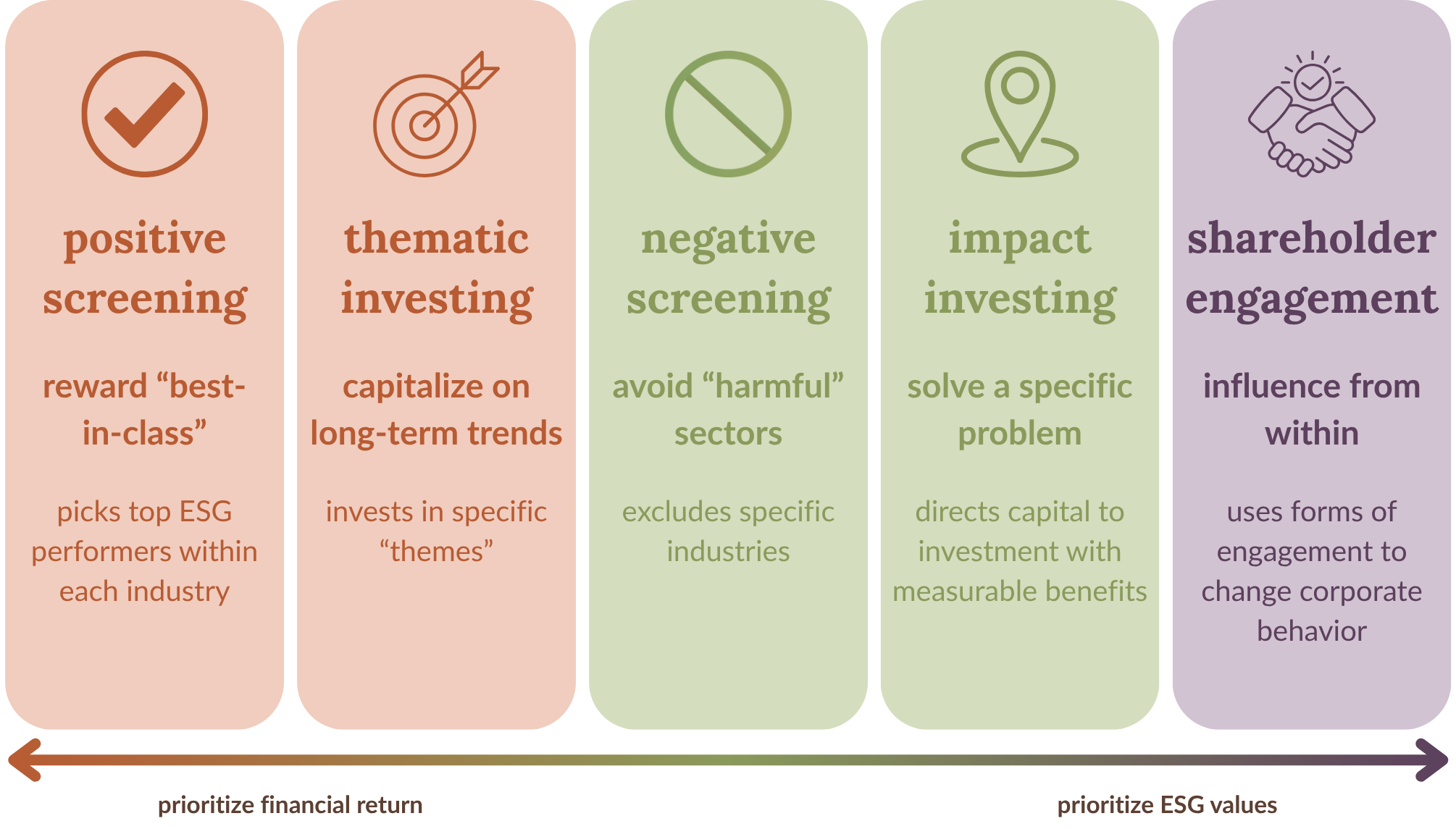
The ESG investing strategies on a spectrum of prioritizing financial return and prioritizing ESG values.
negative screening
what is negative screening?
Negative screening deliberately avoids investment into companies, sectors, or countries from a portfolio that don’t align with specific environmental, social, or governance issues.
how does negative screening work?
A carbon filter improves the quality of drinking water by deliberately absorbing impurities. This is essentially a negative screen. An investment manager designs investments to remove certain companies, sectors, or countries from the portfolio. If a fund is designed to be fossil-fuel free, it might screen out Exxon. If a fund wants to avoid controversial sectors, it might screen out the gambling industry as a whole. If a fund targets specific social issues and does not want to include certain governments, it might screen out China.
who is negative screening for?
Negative screening is often desirable by those who strictly want to avoid “bad” and “controversial” companies, sectors, or countries. This leaves behind a portfolio rigidly aligned with an investor’s environmental, social, and governance values. This is a no-frills approach to weeding out what an investor does not support.
positive screening
what is positive screening?
Positive screening leans into companies with favorable environmental, social, and governance criteria compared to their peers, often referred to as “best-in-class” investing.
how does positive screening work?
When an analyst integrates ESG criteria into traditional financial analysis, a company’s environmental, social, and governance health can be quantified. Under positive screening, this quantification is on a relative basis. An objectively “bad” company, like DraftKings, could be seen as “good” if its peers—other gambling companies—have worse pay disparity, more internal HR complaints, or other harmful ESG issues. Under this hypothetical, DraftKings is viewed as more supportive of ethical issues even as a gambling company. If a fund wants to support companies on the way to making positive change in light of ESG issues, it might include companies in the gambling, oil, or other unethical sectors on a best-in-class basis.
who is positive screening for?
Positive screening is often preferred among investors who want to primarily prioritize financial return, with ESG concerns secondary. The argument for this is simple: negative screening of whole sectors leaves you less diversified and could abstain you from higher expected returns. This is a balanced approach for the return-focused ESG investor.
impact investing
what is impact investing?
Impact investing refers to investment into organizations, funds, or businesses with the explicit intention of generating positive environmental, social, and/or governance impacts alongside financial return.
how does impact investing work?
While some ETFs and mutual funds have specific impact objectives, specialized investments do the heavy lifting here. Traditional impact investments allocate money directly to the cause: solar farms to reduce carbon footprint, Community Development Financial Institutions to build affordable housing, and more. These investments have transparent objectives not to be strayed from while earning a financial return. Because of its narrow nature, this option typically reserves itself to higher-net-worth individuals, but modern technology has been chiseling at this capital barrier. Options without such a financial prerequisite have become available, and more are to follow.
who is impact investing for?
Impact investing is for intentional, specific outcomes. Above financial return and regardless of risk, the primary priority for impact investors is what their money is accomplishing. If an investor wants to watch their money directly impact solar and wind farm production or affordable housing development, this is the instrument of choice.
shareholder engagement
what is shareholder engagement?
Shareholder engagement is the practice of an individual investor or investment manager working directly with a company to improve upon environmental, social, and governance issues.
how does shareholder engagement work?
Engagement between investor and company can take various shapes. Voting, private dialogue, and shareholder resolutions are the circle, square, and triangle of these shapes. There are other, more forceful activist methods of engagement but those are reserved for the institutional world.
Investors are afforded certain rights as shareholders of companies—one of which being votes. With this right to vote, individuals and investment managers can cast votes on issues reaching into environmental, social, and governance issues with items covering executive pay, carbon emission goals, and more. While voting is an external, more accessible form of engagement, some investment managers go a step further and actively communicate with companies. These conversation vary in scope, but often cover company practices influencing environmental and stakeholder impact. The goal of these conversations is to encourage positive change more directly. The in-between is a cross between voting and dialogue: shareholder resolutions. These are formal proposals submitted by stockholders. Here is a thorough list of current resolutions by As You Sow, a non-profit promoting environmental and corporate responsibility through shareholder advocacy.
who is shareholder engagement for?
Shareholder engagement is for those who want active involvement with the companies they invest in—both high- and low-ESG performing companies. This is the approach for investors who want their investment to actively shape company practices in support of environmental, social, and governance issues.
thematic investing
what is thematic investing?
Thematic investing aims to identify companies positioned to perform favorably, focused on long-term trends aligned with personal values and forward-looking conviction.
how does thematic investing work?
Forward-looking conviction does not necessitate positive or negative environmental, social, or governance change. Instead, the performance-focused use of thematic investing is rooted in capitalizing on long-term trends. But personal values—those in line with ESG—often find themselves in the thematic space, like renewable energy. In a renewable energy thematic fund, only companies working directly, or indirectly, on renewables will be included.
who is thematic investing for?
Thematic investing is for investors with positive forward-looking conviction on a specific sector’s performance which may or may not be in line with particular environmental, social, and governance issues.
Disclosures:
Just Advising LLC is a Registered Investment Adviser in the state of North Carolina. Advisory services are only offered to clients or prospective clients where Just Advising LLC and its representatives are properly registered or exempt from registration. Justin Horowitz is an investment adviser representative of Just Advising LLC. The firm is a registered investment adviser and only conducts business in jurisdictions where it is properly registered, or is excluded or exempted from registration requirements. Registration as an investment adviser is not an endorsement of the firm by securities regulators and does not mean the adviser has achieved a specific level of skill or ability.
Content is for educational purposes only and does not constitute a solicitation or offer to buy/sell any securities or provide personalized investment advice. Past performance is no guarantee of future results. All investments involve risk, including the loss of principal. “Likes” should not be considered a positive reflection of the investment advisory services offered by Just Advising LLC. "Likes," "Shares," or "Comments" are not endorsements of any individual or service. Just Advising LLC is not responsible for the content or accuracy of third-party websites linked herein. Comments are monitored but should not be considered testimonials.
The information presented on this post is believed to be factual and up-to-date, but we do not guarantee its accuracy and it should not be regarded as a complete analysis of the subjects discussed. Comments should not be construed as an offer to buy or sell, or a solicitation of an offer to buy or sell the investments mentioned. A professional adviser should be consulted before implementing any of the strategies discussed. Investments involve varying degrees of risk, and there can be no assurance that any specific investment or strategy will be suitable or profitable for a client's portfolio. All investment strategies can result in profit or loss.
Environmental, Social, and Governance (ESG) investing is qualitative and subjective by nature. There is no guarantee that the criteria used or the investments selected will reflect the beliefs or values of any particular investor. ESG strategies may limit the types and number of investment opportunities available, which could cause a portfolio to underperform the broader market or other strategies that do not utilize ESG criteria. Past performance of ESG-related investments is not an indicator of future results, and there is no assurance that an ESG-oriented approach will result in better performance or lower risk.
