
when did ESG investing begin?
“Money is a terrible master but an excellent servant.”
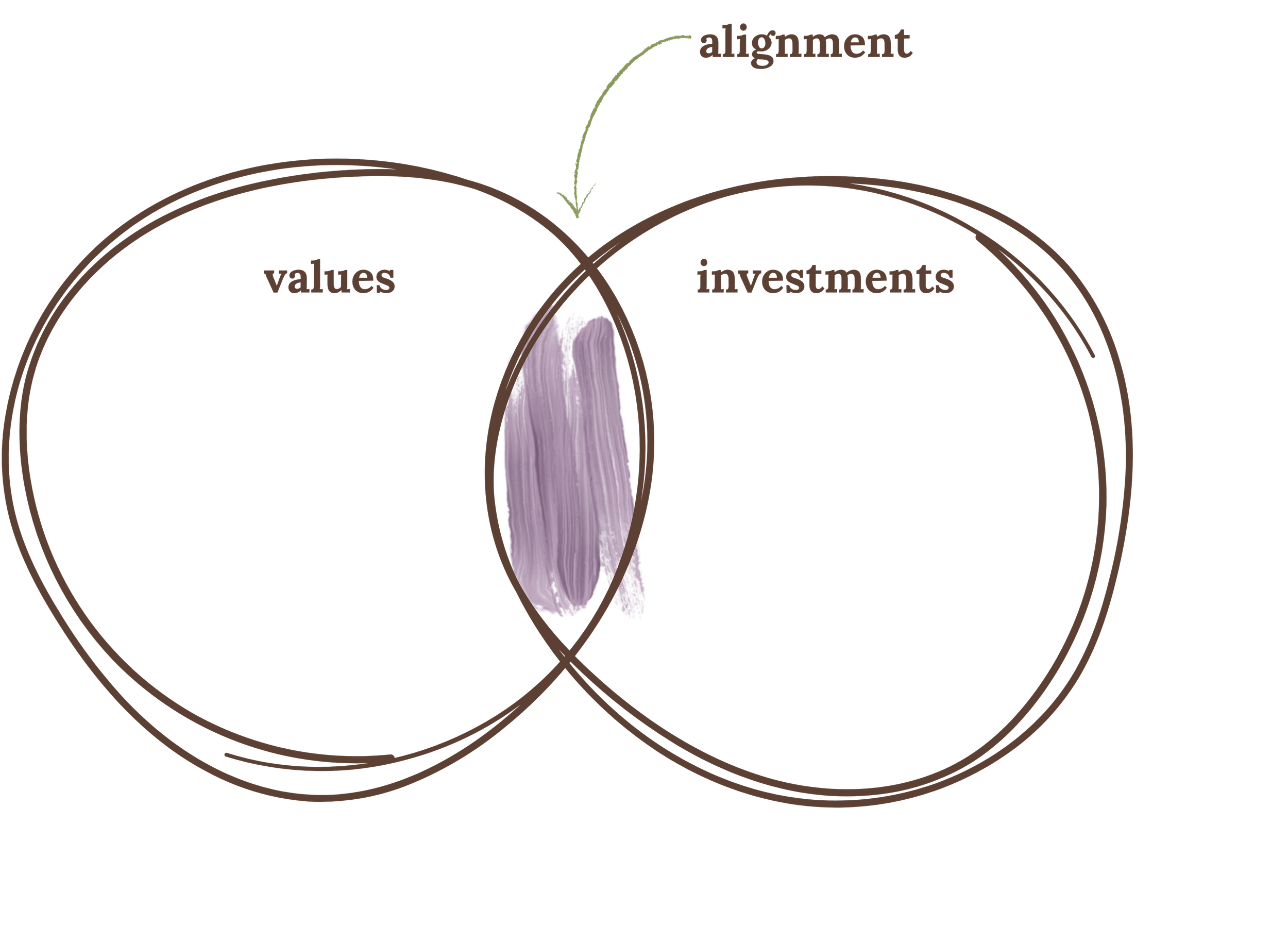
The intersection of values and investments is alignment.
Living in alignment decreases the risk of compromising on your values or your investments. A life denied of values lacks fulfillment, while a life ignoring investments lacks freedom. Is one without the other even possible?
ESG is a myth
Acronyms manifest as mud clogging a hiker’s tread. They are viscous dirt drowning the tension where Earth converses with the sole. E-S-G has become mud.
What began as a moral aspiration has been suffocated by the invisible hand. Paradoxically, corporate players have planted subjective intent into Environmental, Social, and Governance (ESG) labels—strangling the refuge with an overgrowth of weeds. Today, varying interpretations flood these labels with confusion, distrust, and misguidance.
While “ESG” today is shrouded in mystery, the foundation is bedrock inlaid with religion, tradition, and reason. 4,000 years ago, peering into the Biblical Era, Judaic tradition comingled capital and conscious. Later, Sharia law codified ethical capital, the Quakers exemplified the concept of socially responsible investing, and early Methodists wove exclusionary screening for capital. Conscience gave birth to consequential currency.
Gospel enabled the genesis of good-over-gold, but secularism tethered the philosophy to an alignment of values and capital. During the 1970’s, Americans screamed their protest of the Vietnam War not in words, but in Dollars, and later the chains of apartheid in South Africa brittled along a strangulation of Rand. Currency and values continued to harmonize.
Everyone can now manifest change. Although the acronym, ESG, is diluted by profiteering suites, ancient foundations and supporters relentlessly push forward. Standardization through global treaties, local movements, and individual devotion continue to expand access to creating change with currency.
the jist
4,000 years ago, Judaic tradition laid the groundwork for aligning money and values. Charity was a personal motivation, farms left portions for the poor, and deceptive business practices were forbidden by law. Sharia law in Islamic finance followed a similar path, with obligatory wealth distributions, prohibiting interest, and avoiding investment in haram industries. Later, Methodists would also use money to avoid industries harmful to society and the environment, and Quakers would use money to boycott the slave trade.
Nearing present day, in the late 1900s, we saw the launch of the first U.S. publicly traded mutual fund avoiding companies involved in the Vietnam War—specifically avoiding companies in the production of Agent Orange. With similar ethical motivations, students across American colleges and universities protested until educational endowment funds, and other U.S. companies, started to divest from the Apartheid Regime in South Africa. This was a critical piece in the end of that regime.
Into the 2000s, we now see international adoption of various ESG standards and reporting frameworks, as well as international treaties. This era has been met with political whiplash and public questioning, but good work persists. Companies have continued to increase sustainability efforts and investment has continued to grow. What is most important is we do not forget the origination of aligning money and values. Even though politics wants us to think this alignment is great for profits, and while it might be, that is not the goal—the goal is change.
religious origins
Judaic Tradition
4,000 years ago, Judaic tradition engraved righteousness into capital—through tzedakah, pe’ah, and ona’ah—shielding society from the gravity of ego.
Tzedakah: Translated to “justice” or “righteousness,” tzedakah fortified society with an innate sense of charity. This manifested a collective moral code grounded in ethical distributions of capital to the underserved. People silently donated out of personal conviction—not public praise.
Pe’ah: Borne as an agricultural law, pe’ah enforced an early form of corporate social responsibility: mandating the poor have access to nourishment. Landowners preserved a corner of their field unharvested, allowing those whose pockets and stomach remained empty to feed off their land.
Ona’ah: Talmudic law of the Jewish people forbade deceptive conduct during the practice of business. Ona’ah reinforced community, granting trust and honesty to benefactors of trade.
Islamic Finance
Nearby, Islamic finance—through avoiding harm, prohibition of riba, and zakat—sculpted capital with social justice and equitable distributions as its armature.
Avoiding harm: Alcohol, gambling, weapons, and pork are haram. Forbidden. Investment unilaterally favored ethical contributors of society and avoided haram industries outlined in Sharia law. An ancient, and possibly the first, example of negative screening.
Prohibition of riba: Liberating society of riba, an Arabic word in reference to unequal exchanges or fees for borrowing (interest), encouraged fair transactions. In Sharia law, interest mirrored an exploitative and unjust nature.
Zakat: Islamic society embed social responsibility into its roots through mandatory charitable contributions: zakat. As one approached nisab—the minimum threshold of wealth above basic necessities—obligatory contributions preserved fair distribution of capital.
Methodists and Quakers
During the dusk of the 18th century, Methodists and Quakers continued propagating different forms of conscience capital.
In 1744, John Wesley delivered his most influential sermon: The Use of Money. His Methodist followers were instructed to abstain from industries that harmed their neighbors and the environment. Methodism began fermenting society with exclusionary screening.
Quakers introduced opposition to the slave trade. During the 1758 Philadelphia Yearly Meeting, members boycotted the slave trade by withholding further investment. After 1776, slave-owning Quakers would be disowned. Pacifist in nature, Quakers also refrained from the weapons industry—exemplifying socially responsible investing.
modern regulation
ESG has metamorphosed from a religious-based code to a secular Swiss Army Knife of political and environmental stewardship. Since the 1960s, alignment of capital and conscience has loudly approached its zenith. Wars, apartheid, Wall Street, United Nations, and global players have crowd surfed this moral code to the public domain.
1960s and 1970s
The Vietnam War gave birth to the Pax World Fund: the first U.S. publicly traded mutual fund launched in 1971 to incorporate social and environmental criteria. This fund disinherited companies of investment by excluding them from its makeup—specifically companies involved in the production of Agent Orange.
On April 22, 1970, Earth was granted its own day: Earth Day. Twenty million Americans protested for environmental protection, fertilizing political groundwork for the formation of the Environmental Protection Agency.
1980s
Apartheid in South Africa continued to swell until it became a global concern. Students across American colleges and universities began advocating for their educational institutions to divest from companies doing business in the country. By the closing of the 1980s, 200 U.S. companies amputated South Africa from operations—the country’s economy began to hemorrhage. This divestment by American educational institutions and companies alone did not end apartheid in South Africa, but it was critical and now serves as an example.
1990s
The ESG movement garnered institutional and regulatory authority in this decade. John Elkington—the godfather of sustainability—unveiled the “Triple Bottom Line” framework: people, planet, and profit. Practicing with this 3P formula, businesses were urged to forgo the archaic profit-centric manifesto for one embracing social, environmental, and economic impacts.
1990: The Domini 400 Social Index launched—the first equity index tracking companies with strong environmental, social, and governance values.
1997: The Global Reporting Initiative (GRI) was founded and standardized non-financial disclosures for global corporations.
Also 1997: The Kyoto Protocol, a legally binding international treaty, was born and required industrialized nations to reduce greenhouse gas emissions. This would later be superseded by the Paris Agreement.
2000s
2004: The infamous acronym, ESG, is written into conception. The publication of the United Nations Global Compact report “Who Cares Wins” cemented the integration of environmental, social, and governance ideals into capital market operations. This coined the term ESG.
2006: The Principles for Responsible Investment, a voluntary international hive of financial institutions, was created. This UN-supported community nurtures six core principles—incorporate ESG, active ownership, appropriate disclosure, promote acceptance, work together, and report activities—to foster long-term returns aligned with societal goals. Today, 1,500 institutions, and counting, manage $62 trillion in assets driven with these six core principles.
2010s
2011: The Sustainability Accounting Standards Board was founded by Jean Rogers. Accounting rules reflecting ESG’s materiality to a company’s profits now existed.
2015: The UN introduced the 17 Sustainable Development Goals, the Financial Stability Board established the Taskforce on Climate-related Financial Disclosures, and the Kyoto Protocol was superseded by the Paris Agreement—a tipping point for ESG.
2017: At the World Economic Forum 2017 summit, over 140 CEOs signed The Compact for Responsive and Responsible Leadership, committing to an alignment with the UN’s 17 Sustainable Development Goals.
today’s outlook
The religious torch that ignited conscience within capital has engulfed present day markets. ESG has gone mainstream. Various governmental, institutional, and personal motivations champion this change—even through years accompanied with growing pains.
Although this era has asked us to question where ESG is heading, its roots have not been dislodged from what it stands for today. Yes, the U.S. has formally removed itself from the Paris Agreement and companies have tiptoed with careful words around ESG, among other consequences. But this is not doomsday. In the quietness of these changing tides, companies are still advancing sustainability efforts. The shift from boastful proclamations to tempered actions mirrors a sophistication of practices—companies no longer want sustainability efforts in the political limelight.
As we endure headwinds reminiscent of any change, we may recall history to embrace our progress. And remember, our ancestors did not marry conscience and capital to chase profit margins—it was the pursuit of a better society.
Disclosures:
Just Advising LLC is a Registered Investment Adviser in the state of North Carolina. Advisory services are only offered to clients or prospective clients where Just Advising LLC and its representatives are properly registered or exempt from registration. Justin Horowitz is an investment adviser representative of Just Advising LLC. The firm is a registered investment adviser and only conducts business in jurisdictions where it is properly registered, or is excluded or exempted from registration requirements. Registration as an investment adviser is not an endorsement of the firm by securities regulators and does not mean the adviser has achieved a specific level of skill or ability.
Content is for educational purposes only and does not constitute a solicitation or offer to buy/sell any securities or provide personalized investment advice. Past performance is no guarantee of future results. All investments involve risk, including the loss of principal. “Likes” should not be considered a positive reflection of the investment advisory services offered by Just Advising LLC. "Likes," "Shares," or "Comments" are not endorsements of any individual or service. Just Advising LLC is not responsible for the content or accuracy of third-party websites linked herein. Comments are monitored but should not be considered testimonials.
The information presented on this post is believed to be factual and up-to-date, but we do not guarantee its accuracy and it should not be regarded as a complete analysis of the subjects discussed. Comments should not be construed as an offer to buy or sell, or a solicitation of an offer to buy or sell the investments mentioned. A professional adviser should be consulted before implementing any of the strategies discussed. Investments involve varying degrees of risk, and there can be no assurance that any specific investment or strategy will be suitable or profitable for a client's portfolio. All investment strategies can result in profit or loss.
Environmental, Social, and Governance (ESG) investing is qualitative and subjective by nature. There is no guarantee that the criteria used or the investments selected will reflect the beliefs or values of any particular investor. ESG strategies may limit the types and number of investment opportunities available, which could cause a portfolio to underperform the broader market or other strategies that do not utilize ESG criteria. Past performance of ESG-related investments is not an indicator of future results, and there is no assurance that an ESG-oriented approach will result in better performance or lower risk.
